

Who Is Actually in Control?
Part 3: The Control Gap

What happens when power grows faster than our ability to govern it?
Part 1 → AI Is Changing the Deal (and No One Agreed to It)
Part 2 → When AI Wins, Who Wins?

Most of modern life runs on a quiet assumption:
Somebody is steering.
Maybe it’s the company. Maybe it’s the regulator. Maybe it’s the board, the courts, or the government. We may not know exactly who is in charge, but we tend to believe someone, somewhere, understands the system well enough to intervene when necessary.
That belief matters more than we realize.
We board airplanes we cannot build. We take medicine we cannot formulate. We trust financial systems we do not fully understand. We participate in increasingly complex digital platforms because we assume there are rules, oversight, and accountability structures surrounding them.
The assumption has never been perfect.
And AI is beginning to test it more than we may realize.
In the first piece in this series, I wrote about the Permission Gap: the space between what companies are technically capable of doing and what people believe they have the right to do.
In the second, I wrote about the Extraction Zone: what happens when value created by many increasingly flows to a small number of owners.
This third piece is about what comes next.
The Control Gap.
The Control Gap is the space between the power of these systems and our ability to meaningfully govern them.
And right now, that gap is widening.
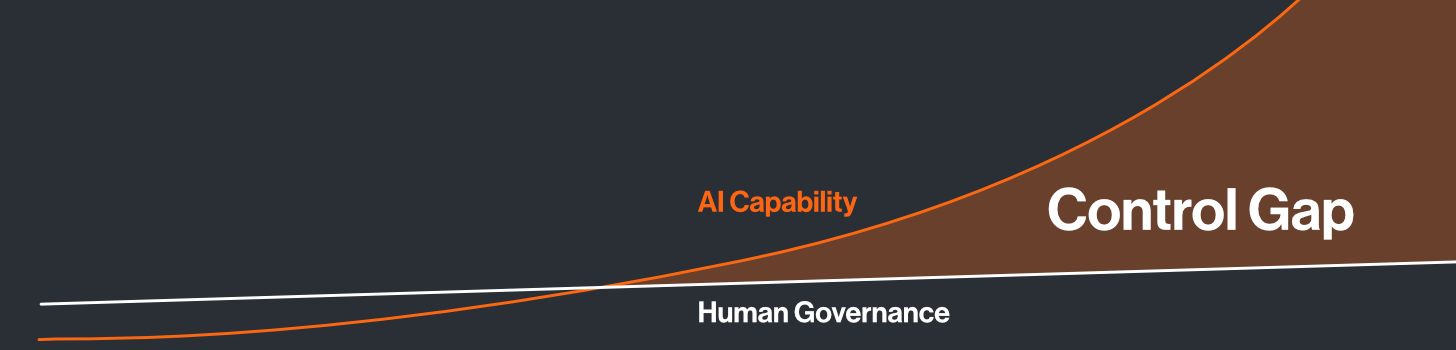
Most governance systems were built for a slower world. Quarterly reviews. Annual planning cycles. Regulatory processes measured in years. They were designed for products and institutions that changed slowly enough to be observed, understood, and challenged.
AI doesn’t operate on that timeline.
Models evolve continuously. Capabilities emerge unexpectedly. Products change faster than institutions can evaluate them. By the time a committee reviews the risks, the system may already be different than the one they intended to govern.
That is not oversight.
It is delayed observation.
This is why the challenge is deeper than regulation.
The issue isn’t simply whether we have the right rules. The issue is whether the people responsible for governing these systems can understand them quickly enough to remain credible.
Because control is not ultimately about authority.
It’s about understanding.
We tend to assume those two things are the same. Historically, they often were. The people making decisions generally had a reasonable understanding of the systems they controlled. If something went wrong, someone could explain what happened. Someone could be held accountable.
AI introduces a different possibility.
What happens when authority and understanding begin to separate?
What happens when the people approving a system don’t fully understand it, the people affected by it can’t inspect it, and even the people building it cannot always explain why it produced a particular result?
That changes the nature of accountability itself.
Increasingly, AI-influenced systems are helping shape decisions about employment, credit, insurance, pricing, visibility, reputation, and access to information. In many cases, the people affected by those decisions have little ability to understand how they were made.
And when people cannot see a system, question it, challenge it, or stop it, trust begins to change.
Not disappear.
Change.
Trust becomes less about accountability and more about faith.
Faith that the system is working.
Faith that someone understands it.
Faith that somebody is still steering.
That’s a fragile foundation.
I’ve sat in rooms where smart, responsible leaders discuss AI governance frameworks while admitting they do not fully understand how AI is already being used inside their own organizations. This isn’t a story about negligence. In many cases, it’s the opposite. People are trying their best to govern responsibly.
The problem is velocity.
The systems are moving faster than the structures surrounding them.
And that tension is becoming normal.
That’s what concerns me.
Because power does not become legitimate simply because it becomes familiar.
The most significant risks rarely arrive all at once. They become embedded gradually. First a technology is useful. Then it becomes convenient. Then it becomes essential. Eventually it becomes difficult to imagine functioning without it.
The same pattern appeared in the Permission Gap.
The same pattern appeared in the Extraction Zone.
→ First convenience
→ Then dependence
→ Then opacity
By the time people begin asking harder questions, the system is already woven into everyday life.
To be clear, this is not an argument against AI.
AI will improve countless things. It will accelerate research, increase productivity, unlock creativity, and solve problems that are difficult to solve today.
The question is not whether the technology works.
The question is whether the systems gaining power remain governable.
Can they be explained?
Can they be challenged?
Can responsibility be assigned when something goes wrong?
Can meaningful human accountability survive at machine speed?
Those are governance questions.
Those are legitimacy questions.
And legitimacy matters because institutions ultimately run on trust. People do not expect perfection. They do not require every decision to be correct. But they do expect a path to explanation, correction, and accountability.
Without that, trust doesn’t simply decline.
It changes category.
It becomes blind faith.
And blind faith is not a durable foundation for markets, governments, corporations, or democratic societies.
This is the real risk of the Control Gap.
Not machine consciousness.
Not killer robots.
Not the science-fiction scenarios that dominate headlines.
The more immediate risk is that more and more people look at the systems shaping their lives and conclude that no one is meaningfully steering them.
Not the companies.
Not the regulators.
Not the governments.
Not even, fully, the builders.
At that point, the crisis is no longer technological.
It becomes institutional.
Because power and control are not the same thing.
A system can become more powerful without becoming more governable.
A company can become more capable without becoming more accountable.
A society can become more technologically advanced while feeling less in control of its own direction.
That is the future we should be paying attention to.
Not because the technology will stop.
It won’t.
But because legitimacy has to keep pace with power.
And if no one can meaningfully explain the system, no one can meaningfully govern it.
Which leaves us with the question this series has been circling from the beginning:
If the deal has changed, if the value is being redistributed, and if the systems are moving faster than our ability to govern them...
Who is actually in control?
